

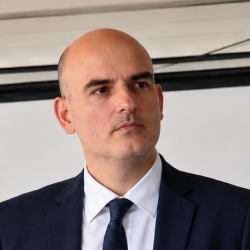
Konstantinos V. Katakalos is an Associate Professor in the Department of Civil Engineering at the Aristotle University of Thessaloniki, Director of the Sector of Structural Science and Technology, and Director of the Laboratory for Experimental Strength of Materials and Structures (EPAYK). He holds a Diploma in Civil Engineering from AUTh, two Master's degrees — in Earthquake Engineering and in Civil & Environmental Engineering from the University of Massachusetts Dartmouth (USA) — and a PhD from AUTh, awarded with distinction.
His scientific and research activity spans earthquake engineering, experimental mechanics, structural reliability, assessment and strengthening of existing structures, advanced composite materials, shape-memory materials, and the protection of monuments and historic structures. He has made decisive contributions to the development and application of innovative structural strengthening technologies, as well as to introducing new research fields that connect materials science with the contemporary needs of technical works and cultural heritage.
He has participated in more than sixty national and international research programs, serving as scientific lead on a significant number of them (52) and managing research activities that combine basic and applied research. His published work includes a large number of papers (172) in high-impact international scientific journals, book chapters, international conference proceedings, and international patents, which have contributed to advancing knowledge in the fields of seismic protection, advanced materials, and construction technology.
His research contribution has been internationally recognized through extensive citations, scientific collaborations, and participation in international research and innovation networks. At the same time, he has long-standing professional experience in the design, supervision, and restoration of complex technical works, monuments, and special structures, serving as a technical advisor to public organizations, ecclesiastical bodies, and charitable institutions.
Beyond his academic and research work, he has been significantly involved administratively through participation in institutional bodies of the Aristotle University of Thessaloniki, the Region of Central Macedonia, the AHEPA University Hospital, and other public-sector bodies, actively contributing to shaping research, innovation, and technical development policy.
In summary, his work is characterized by the connection between scientific research and practical application, and by the transfer of know-how from the laboratory to the field of real construction projects and cultural heritage works
