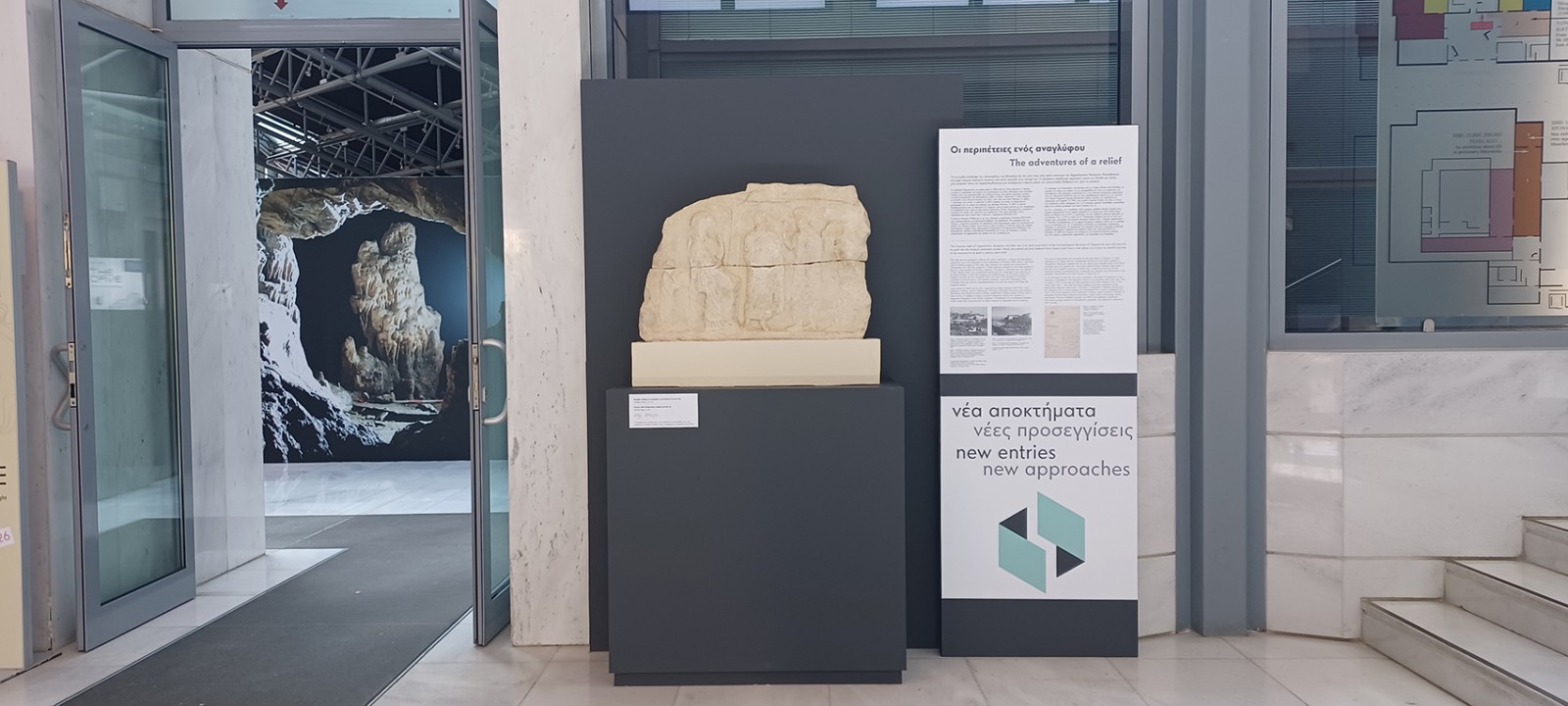
As part of the exhibition series titled “New Acquisitions / New Approaches”, a prominent display case in the museum’s reception area welcomes visitors, introducing them to some of its most interesting new and old antiquities.
Objects either recently acquired and presented for the first time to the scholarly and general public, or retrieved from the storage shelves to be exhibited under a new approach, following a restoration process, a new interpretation, or based on new scientific data.
Τhe adventures of a relief
The funerary relief of Hippostratos, Antigona, and their son is an early acquisition of the Archaeological Museum of Thessaloniki and until recently its path into the museum remained unclear. Newly discovered archival material from Greece and France now allows us to trace its eventful journey to the museum for at least a century and a half.
The relief was first published in 1860 by the French researcher L. Heuzey, who discovered it among the ruins of the Monastery of Saint Athanasios in Kolindros, Pieria, where it had been used as building material. A few years later, however, the sculpture was transported to Thessaloniki, as in 1869 the researcher P. Vidal-Lablache recorded it in the Greek quarter of the city, in the courtyard of the Bitsos residence. In 1887, the sculpture was published again by the British scholar D.G. Hogarth, this time with the information that it was kept in the courtyard of the British Consulate. From that point on, the mistaken impression arose that it belonged to the Consulate. How did this misunderstanding occur, and who exactly was Bitsos, the supposed owner?
Recent research on the collector Bitsos and his activities has brought to light previously unknown archival documents, offering new information about his identity as well as about the collection of Macedonian antiquities he maintained in Thessaloniki during the second half of the 19th to the early 20th century. The fate of the collection had remained unknown until today, which is quite common for early private archaeological collections. In the case of the Bitsos collection, however, we have, as was recently established, a rare exception. Thanks to a series of circumstances, almost the entire collection ended up in the holdings of the Archaeological Museum of Thessaloniki, making it the oldest archaeological collection from the 19th century preserved in the museum.
If you would like to learn more about the relief of Hippostratos and the Bitsos archaeological collection, visit the “New Acquisitions / New Approaches” section at the Archaeological Museum of Thessaloniki. At regular intervals, which will be announced on our website, short guided tours by a museum archaeologist will be offered.