How did people in antiquity perceive colours? What meanings did they attribute to them, and how were colours connected to their senses and understanding of the world? What can modern scientific methods reveal about the colours that once adorned ancient sculptures and architectural monuments?
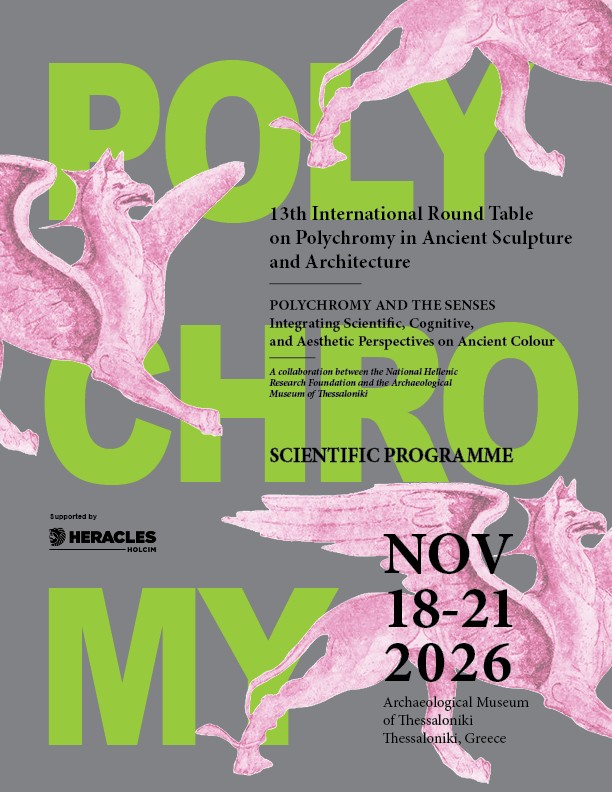
These questions lie at the heart of the 13th International Round Table on Polychromy in Ancient Sculpture and Architecture, which will take place from 18 to 21 November 2026 at the Archaeological Museum of Thessaloniki, co-organised with the National Hellenic Research Foundation. The conference has been made possible through the generous cultural sponsorship of HERACLES Group.
The Polychromy Round Table is an established international scientific gathering that has been held at major museums and research institutions worldwide since 2009. Under the theme “Polychromy and the Senses: Integrating Scientific, Cognitive, and Aesthetic Perspectives on Ancient Colour”, this year’s conference explores not only the materials and techniques of ancient polychromy, but also how colour was perceived and acquired meaning in antiquity.
The conference brings together nearly 100 researchers from universities, museums and research institutions in Greece and abroad, including the Metropolitan Museum of Art in New York, the J. Paul Getty Museum, the British Museum, the Louvre and the University of Oxford. The programme comprises eleven thematic sessions and three keynote lectures, delivered by Maria Michela Sassi, Vinzenz Brinkmann and Ulrike Koch-Brinkmann, and Adam Lowe. Presentations address ancient colour terminology, archaeometric research, painting and sculpture, sensory experience, and digital reconstructions, including the use of artificial intelligence.
Ancient Macedonia features prominently in the programme, with a dedicated session on painting, funerary practices and the display of social status, presenting new research findings from Aigai and Thessaloniki.
The Organising Committee comprises Dr Charikleia Brecoulaki (National Hellenic Research Foundation), Dr Anastasia Gadolou (Hellenic Ministry of Culture), Dr Styliana Galiniki and Dr Christos Katsifas (Archaeological Museum of Thessaloniki).
The conference will be held in the Museum’s “Manolis Andronikos” Lecture Hall. The official language is English.
As part of the conference, the Archaeological Museum of Thessaloniki will inaugurate its new temporary exhibition, “Seeing the Unseen: Six Stone ‘Panels’ of an Ancient Painting”, on Thursday, 19 November 2026, at 18:00. The exhibition has been developed in collaboration with an international interdisciplinary research team.